Today’s most powerful computers hit a wall when tackling certain problems, from designing new drugs to cracking encryption codes. Error-free quantum computers promise to overcome those challenges, but building them requires materials with exotic properties of topological superconductors that are incredibly difficult to produce. Now, researchers at the University of Chicago Pritzker School of Molecular Engineering (UChicago PME) and West Virginia University have found a way to tune these materials into existence by simply tweaking a chemical recipe, resulting in a change in many-electron interactions.
The team adjusted the ratio of two elements—tellurium and selenium—that are grown in ultra-thin films. By doing so, they found they could switch the material between different quantum phases, including a highly desirable state called a topological superconductor.
The findings, published in Nature Communications, reveal that as the ratio of tellurium and selenium changes, so too do the correlations between different electrons in the material—how strongly each electron is influenced by those around it. This can serve as a sensitive control knob for engineering exotic quantum phases.
“We can tune this correlation effect like a dial,” said Haoran Lin, a UChicago PME graduate student and first author of the new work. “If the correlations are too strong, electrons get frozen in place. If they’re too weak, the material loses its special topological properties. But at just the right level, you get a topological superconductor.”
“This opens up a new direction for quantum materials research,” said Shuolong Yang, Assistant Professor of Molecular Engineering and senior author of the new work. “We’ve developed a powerful tool for designing the kind of materials that next-generation quantum computers will need.”
A tale of two transitions
Iron telluride selenide is a relatively recently discovered material known to exhibit both superconductivity and exotic topological properties.
“This is a unique material because it brings together all the essential ingredients one would hope for in a platform for topological superconductivity: superconductivity itself, strong spin–orbit coupling, and pronounced electronic correlations,” said Subhasish Mandal, an assistant professor of physics at West Virginia University and an author on the new paper. “This combination makes it an ideal system in which to explore how different quantum effects interact and compete.”
In the past, researchers have grown bulk crystals of the material and observed unusual quantum states, but bulk crystals are difficult to work with, and their composition can vary from spot to spot.
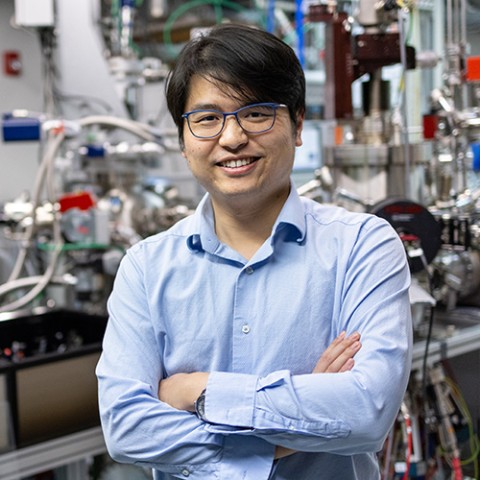
Yang, Lin, and their colleagues grew thin films of iron telluride selenide just 10 atomic layers thick, realizing the kind of films that are needed to fabricate quantum devices. Then, they precisely controlled the ratio of tellurium to selenium.
As the tellurium content increased past 70%, the team observed a first transition: the material switched from topologically trivial to non-trivial, developing the protected surface states that make it useful for quantum computing. This transition had been predicted by theory and observed in bulk crystals.
But near pure iron telluride, something unexpected happened. The topological surface state vanished, and the material returned to a topologically trivial phase. Christopher Jacobs, a graduate student in Mandal’s group at the Department of Physics and Astronomy at WVU, turned to advanced computational methods to explain the transition. They revealed that the correlated motion of electrons within the material changed as tellurium concentrations increased, and those electron correlations drove the quantum and topological states.
“Seeing this delicate balance unfold experimentally was both surprising and illuminating,” said Mandal. “It points to electronic correlations as a powerful and previously underappreciated tool for engineering topological quantum matter.”
The observation highlights the fact that quantum materials are not fixed objects; they can be actively tuned by subtle internal interactions, he added.