UChicago PME Distinguished Speaker Colloquium - Bert M. Weckhuysen
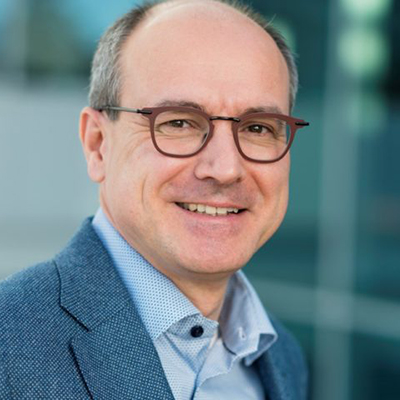
- When:
- Thursday, November 6, 2025 4:00 pm - 5:00 pm
- Where:
- WERC 161
- Speaker:
- Professor Bert M. Weckhuysen, Inorganic Chemistry and Catalysis group, Institute for Sustainable and Circular Chemistry, Department of Chemistry, Utrecht University
- Description:
-
Operando Spectroscopy of Catalyst Materials: The Past, Present and Future
Scientists have been hunting for the “active site” in catalysis, thereby elucidating the reaction and deactivation mechanisms of important processes for the production of fuels, chemicals and materials, including plastics and coatings. This ambition is certainly not a trivial one as the concept of “active site”, originally proposed by Hugh Taylor, remains to date elusive. Catalysts have been found to be highly dynamic and evolve as a function of the reaction environment (e.g., composition, temperature and pressure) as well as reaction time. If we wish to capture these dynamics, analytical methods have to be developed and applied to spatiotemporally image catalyst materials at work. This notion lead about 25 years ago to the foundation of the field of “operando spectroscopy”. Crucial is the aspect that spectroscopic measurements must be performed under realistic reaction environments to ensure that the obtained physicochemical data captures relevant information on the catalytic process and hence may interrogate the behavior of the active site. Although simple it its principle, striving towards a true operando experiment is far from trivial, as the conditions for performing spectroscopy measurements are not well aligned with the conditions for performing catalytic measurements. This contradictio in terminis becomes even more apparent when realizing that catalysts should be best studied (a) in their chemical and structural complexity (e.g., shaped catalyst bodies, containing binders and additives) as used in industrial reactors and (b) under industrial-like conditions, including the presence of e.g. poisons, and transient reaction conditions. This lecture starts with some historic notions leading to the foundation of the field of operando spectroscopy. The second part of the talk focuses on important developments of the operando methodology. Three aspects will be highlighted, namely the need for: (a) multiscale characterization approaches, going from the reactor down to the active site; (b) multimodal approaches, integrating complementary methods and (c) catalyst particles as operando temperature and catalytic performance sensors. The third part discusses showcases, which illustrates the complexity of defining what an “active site” may look like in reality. It will be shown how catalysts for CO, CO2 and CH3OH conversion spatiotemporally evolve, how the active sites are in-situ created within the catalyst particles placed in a reactor bed and how they further evolve during these processes. These examples lead to different notions on what an active site may be, and they highlight the importance of synthesis and pretreatment (i.e., the deliberate transformation of a “precatalyst” into its active form) in designing catalysts with the intrinsic potential to generate the highest “density of selective and stable active sites”.